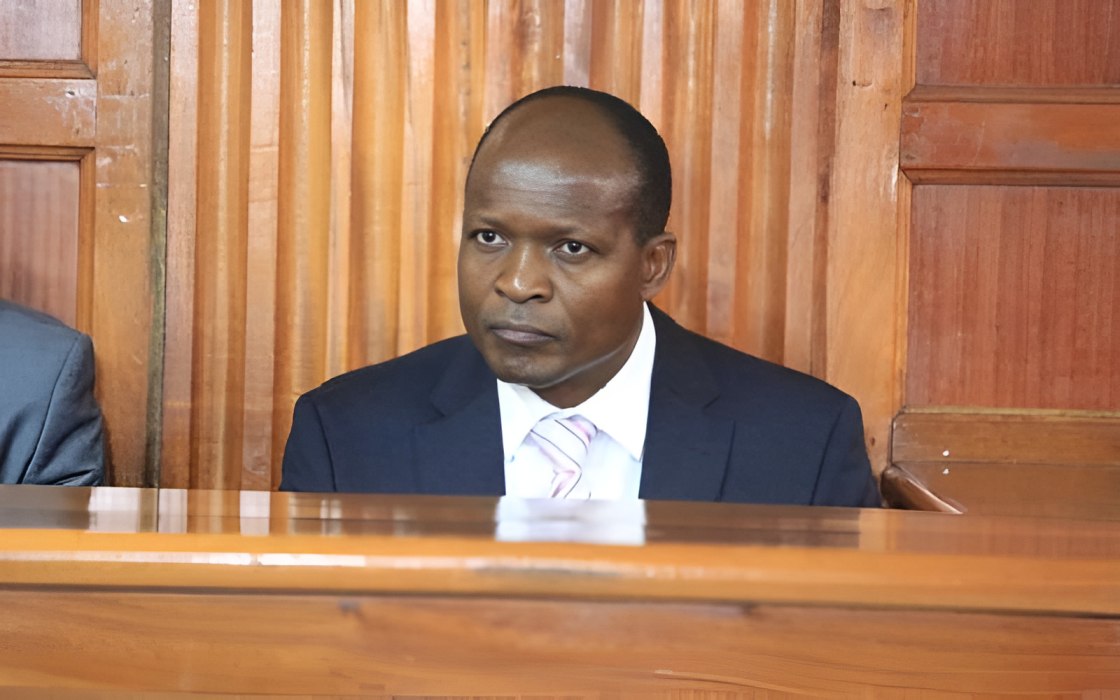
Kenya’s Director of Public Prosecutions has urged the High Court to convict former Migori Governor Zacharia Okoth Obado and two co-accused over the 2018 murder of university student Sharon Otieno. Prosecutors say evidence presented forms a complete picture of a coordinated plan to eliminate her.
In submissions before the Milimani High Court on Friday, the Prosecution, led by Senior Assistant Director of Public Prosecutions Gikui Gichuhi, outlined what it described as a coordinated criminal enterprise culminating in the killing.
According to the DPP’s office, the Prosecution presented “a compelling case demonstrating a coordinated plot and joint criminal enterprise that led to the death in 2018.”
Addressing the court, Gichuhi argued that the case against the accused was built on consistent and interlocking strands of evidence.
“The evidence paints a coherent picture of the accused acting in concert, with a shared intention to eliminate Sharon Otieno and silence witness (XYZ) to avoid political fallout, reputational harm, and embarrassment to Governor Obado,” Gichuhi told the court.
The Prosecution further stated that the two co-accused, Michael Juma Oyamo and Casper Ojwang Obiero, were central to the alleged scheme. It said they acted as trusted operatives and were directly involved in events leading up to the killing.
According to court submissions, the pair were present at Graca Hotel on the evening of September 3, 2018 when the deceased and XYZ were abducted.
The Prosecution also pointed to the vehicle allegedly used in the operation. “The vehicle used, registration number KCL 418K, is registered to Obiero’s wife and driven by a longtime associate,” the DPP’s office said.
In building its case, the Prosecution told the court it had assembled extensive evidence spanning several investigative disciplines.
Gichuhi detailed witness accounts, cybercrime findings, telephone data analysis and forensic investigations.
“From the start, we committed to showing the court that the evidence, like pieces of a puzzle, form a complete picture of the events that led to Sharon’s tragic death,” she said.
The DPP dismissed the defence case as inconsistent and lacking credibility. Prosecutors argued that the defence narrative was constructed after the fact and designed to deflect responsibility.
According to the DPP, the Prosecution dismissed the defence as inconsistent and constructed on afterthoughts designed to mislead, noting that no reasonable doubt exists.
The three accused Obado, Oyamo and Obiero, have been charged with the murder of Sharon Otieno. The High Court has previously ruled that they have a case to answer, meaning the trial proceeded to the defence stage before closing submissions.
The killing of Sharon Otieno in 2018 drew widespread public attention and raised questions about political influence and witness protection.
The current proceedings focus on whether the evidence presented meets the legal threshold required for conviction.
Following the latest submissions, the court is expected to reconvene on March 18, 2026 to announce the date when judgment will be delivered.
As the trial nears its conclusion, the Prosecution maintains that the evidence establishes a joint criminal enterprise and proves the accused acted together with a shared objective.
“The evidence paints a coherent picture of the accused acting in concert,” Gichuhi reiterated in court, insisting that the pieces of evidence, taken together, leave no room for doubt.
The final decision now rests with the High Court, which will determine whether the prosecution has proven its case beyond reasonable doubt.